Title: Doctor Sleep
Author: Stephen King
Genre: horror, paranormal
Series: The Shining
A few starting notes:
It's probably no great surprise to anyone by now that this is the sequel to The Shining. With that in mind, I do recommend that you read The Shining first - you'll just get so much more out of Doctor Sleep if you do. I'm going to keep this spoiler-free, with the exception of anything you can learn from reading the blurb for Doctor Sleep - because I think that's only fair.
Sorry if this is an honest-to-God ramble but I figured I'd get my thoughts down on (metaphorical) paper. We've heard a lot lately about extremism, and I wanted to add my stance on the smart way forward. It includes books and words, which, as we know, are the best weapons.
So, I guess most people will be aware of the events in Tunisia, France, Kuwait, etc. over the past week. Also the events in Syria, Iraq, Libya, Nigeria, etc. over the past months and (in some cases) years. Those who don't know what I'm talking about - just go to any global news website and I'm sure you'll get the point.
But the way forward against IS and Boko Haram and all the other lost and lonely little boys playing at war out there (including white supremacists and their ilk) is not guns, missiles, and bombs. These are not things that they're afraid of - in fact they actively want people to treat them to traditional warfare - to them it vindicates the role they've painted for themselves as under attack and fighting a holy war.
What they are afraid of is a lot more simple than that. Actually, it's a lot more pathetic than that, they're scared of coloured pens. After all, why else would Islamic State ban art and colour from schools?
They're also scared of learning. They're scared of words. Why else would the Taliban shoot Malala Yousefzai? They shot a girl with some books because she was a bigger threat than all of the bombs and guns put together. They're so insecure in both their beliefs and their masculinity that the idea that a woman could learn and think for herself was too frightening for them to let it happen.
The way forward then is not to shoot people - that's the way of the extremists, those lost little boys who want the world to hurt so that they don't have to address their feelings of inadequacy, their isolation from a world they feel they don't fit in to, their daddy issues and abandonment complexes. And their over-compensation for a lack of masculinity.
No, the way forward is far more subtle. Governments and world leaders need to control the narrative - words are powerful. The way to kill ideas is not with bullets (to paraphrase vol 2 (Dallas) of Gerard Way and Gabriel Ba's excellent Umbrella Academy,) it's with words. At the moment, world leaders are reading the script the extremists are writing - words like 'evil' and 'martyr' just perpetuate the sense of conflict, the insistence of Mr Cameron on the importance of 'British values' just makes him look like an idiotic out-of-touch Tory. His values are not mine, I happen to value people and not hurt them out of an idealistic urge to slash funding.
Instead, governments need to focus on what Islamic State would not want them to say. A sense of patronising pity, perhaps, that these boys have been led so far astray that they'll never be able to claw their way back to the lives they could have had, and the people that they could have been.
What needs to be said, and often, are the things that jar with the macho image Islamic State want to have - influential people need to call out the lost little boys and tell them they are jumping at shadows. They are frightened of art. They are frightened of women - frightened to let them wear what they want and think for themselves. They are frightened that what they believe is wrong - and so they defend it blindly without thinking it through. They are people who are so insecure in their faith and in themselves that they feel they must become defensive - like cornered animals.
Of course, the other thing that needs to be done globally, is the better kind of cloak-and-dagger stuff. This is not the assassination, plot-foiling, and secret codes stuff. This is the stuff that opens the minds of others. In short, we have to smuggle books into Islamic State. All books and any books. We need to drop leaflets with satirical cartoons from the planes that would otherwise carry bombs. We know that free speech scares them - Charlie Hebdo showed us that - so that is the weapon we must use.
So, we need to smuggle in classical novels with heroines - Jane Eyre and Moll Flanders - books with dangerously subversive messages - 1984, The Hunger Games - books of magic and fantasy - Harry Potter, J R R Tolkien - and however many Vampire novels and cheesy romance books we can squish into our metaphorical suitcase. There will be ears forever deaf to the voice of liberty and free-thought, but we don't know if we don't try.
Let's screen movies on huge projectors against the walls of buildings, drop art prints into the towns of Syria, poetry into Boko Haram controlled areas of Nigeria. Let's remind people that they're human. Guns and bombs are weak weapons, let's bring out the WMK - weapons of mass knowledge - and bring down these pockets of stupidity from the inside.
Ahhh, just look at that wonderful library haul! Granted, a couple are renewals, but they still all belong to that excellent library pile :) I may have maxed out my library card (damn you ten item policy!) but it was totally worth it!
Title: Diary of a Wimpy Vampire (US Link)
Author: Tim Collins
Genre: ya, paranormal, humour, vampire
Series: Wimpy Vampire
A few starting notes:
 This looked fairly entertaining, and I'm a sucker for vampires (pun only slightly intended.) So I figured, why not give it a try? It's very much aimed at the teenage/ya market.
Premise:
Nigel is a vampire. Vampire's are always romantic and sexy and all that cool stuff - but not Nigel. Nigel had the misfortune of being turned at the awkward age of 15, just in time for an eternity of homework, acne, school politics, and being awkward around girls. So, will Nigel ever reach his target of getting his first ever girlfriend before his 100th birthday?
Best bits:
This book is fun. Like fun. Think of all the diary-form teenage books there have been over the years. Then add an awkward teenage vampire - see? Fun.
The pictures are actually a really fun touch - like something that a teenager would actually use to try and illustrate their hyperbolically serious diary. And I love Nigel's parents; they are, quite awesomely, mental.
The tone and pace of this book is quick and light, making it perfect for reluctant readers (you may even be able to trick the dreaded challenge of the teenage boy into reading it - though I can't guarantee it.)
Not so great bits:
Sometimes the plot has a slight tendency to feel on the thin-side. This isn't too much of a problem because the tone is so light, but it can occasionally get irritating.
There are some light references to issues that might affect teenagers - poverty, self-harm, suicide, anorexia, bullying - but these aren't laid on too thickly so the majority of young readers will be able to cope.
Verdict:
A fun and quick read with an awesome and quirky premise. Perfect for reluctant readers, or just those who like something different every now and then.
This looked fairly entertaining, and I'm a sucker for vampires (pun only slightly intended.) So I figured, why not give it a try? It's very much aimed at the teenage/ya market.
Premise:
Nigel is a vampire. Vampire's are always romantic and sexy and all that cool stuff - but not Nigel. Nigel had the misfortune of being turned at the awkward age of 15, just in time for an eternity of homework, acne, school politics, and being awkward around girls. So, will Nigel ever reach his target of getting his first ever girlfriend before his 100th birthday?
Best bits:
This book is fun. Like fun. Think of all the diary-form teenage books there have been over the years. Then add an awkward teenage vampire - see? Fun.
The pictures are actually a really fun touch - like something that a teenager would actually use to try and illustrate their hyperbolically serious diary. And I love Nigel's parents; they are, quite awesomely, mental.
The tone and pace of this book is quick and light, making it perfect for reluctant readers (you may even be able to trick the dreaded challenge of the teenage boy into reading it - though I can't guarantee it.)
Not so great bits:
Sometimes the plot has a slight tendency to feel on the thin-side. This isn't too much of a problem because the tone is so light, but it can occasionally get irritating.
There are some light references to issues that might affect teenagers - poverty, self-harm, suicide, anorexia, bullying - but these aren't laid on too thickly so the majority of young readers will be able to cope.
Verdict:
A fun and quick read with an awesome and quirky premise. Perfect for reluctant readers, or just those who like something different every now and then.
Title: Ban This Filth! Mary Whitehouse and the Battle to Keep Britain Innocent (US Link)
Author: Ben Thompson
Genre: non-fiction
A few starting notes:
This was picked up in a library haul and seemed pretty interesting. For those who don't know, Mary Whitehouse was the leader of the National Viewer's and Listener's Association and the Clean-up TV Campaign from the 1960s onwards.
Premise:
This is a selection of the letters and documents from the Mary Whitehouse archive (yes, there is apparently such a thing,) and a running commentary by Mr Thompson.
Best bits:
This is quite an interesting book - I only had a sketchy knowledge of Mary Whitehouse before reading (her peak was a bit before my time,) and am always interested in the issue of censorship and the issue of offensive material in the media.
Ben Thompson's commentary is chatty and engaging, and clearly thought through, making the book charming enough to keep you reading. He also does well in framing the many paradoxes of a complex character who became a symbol of right-wing censorship while raising some fundamentally important points along the way.
Not so great bits:
I have to admit that at some points I found Thompson's defence of, and sometimes admiration and affection for, Mary Whitehouse a little wearing. Yes, believe it or not, she occasionally made some good points, but I would've liked a bit more of an acknowledgement that whatever good points she made cannot excuse her blatant homophobia (not to mention other statements made by herself which were more offensive than the stuff she wanted censored.)
The structure of the book - with chapters focussing on a them - could've benefitted from said themes being more juicy. I would've far rathered reading more about the objections she had to things which have since become national treasures (Dr. Who, The Beatles,) than reading about her in-fighting with other Christian organisations such as the Anglican Church. A bit more social context for those of us not born at the time would also have not gone amiss.
Also, and this is not really the book's fault, the jacket was covered with quotes from British reviewers who clearly need to get out more. Yes, the book was amusing in places, but in no way was it 'hilarious' or 'shockingly funny.'
Verdict:
A fair effort to discuss the paradoxes and life of Mrs Whitehouse using the incredibly interesting resource of her own archives. There were minus points to this book, of course, but at the end of the day it is a competent portrait of the work of a woman who was trying (forcefully) to get back to an innocent, idealised, version of this country that never really existed - except perhaps in the minds of people like her.
I'm wondering how you describe audiobooks - do you read an audiobook? Or just listen to it? But then, I like to count audiobooks towards my Goodreads total - so isn't that reading? But somehow my brain won't accept "Oh, I read that audiobook before and..." as valid. Is it just me?
I know a lot of people can be a little sniffy about audiobooks in general - and certainly, I (read? - you see my problem!) audiobooks less than I read printed books with all their word-y-ful wonderment which allows me to actually touch the print (I know, but don't judge me!) But I still kind of like the odd audiobook (by which I mean occasionally listening to an audiobook rather than the audiobooks I listen to are slightly odd - which may also be true, but wasn't what I was getting at.) I think that, maybe weirdly, maybe not, listening to classics in particular in an audiobook format works really well.
Hear me out here! - a lot of classics were published in instalments in magazines and newspapers etc., still more were designed to be read out by one member of the family to the others, or to be read at a formal reading by the others. As such, they were practically made to be listened to and/or read out loud. There was no TV in the 19th Century, so lord knows you had to follow the dramas somehow. Someone in the family would read a chapter or two out loud in the evening as pretty much the only form of at-home entertainment, save playing music or games of cards - so trust me, classics in audiobook format work. (And, if you're skint, try LibriVox - all classics, all free.) And, as ever, if it gets people interested in reading and books, then why ever the hell not? #ShameTheShamers
Title: Notes From a Small Island (US Link)
Author: Bill Bryson
Genre: non-fiction
A few starting notes:
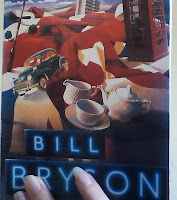 Written about 20 years ago, this nevertheless was on my tbr list simply because I thought that it would be interesting to see how a nominal American (with a strong adoptive link to the UK) would see Britain. Plus Bill Bryson always makes me laugh.
Premise:
Before nipping off in a move back over the pond with his kids to give them a taste of American life, Bill Bryson decides to do a tour of the UK to say farewell to a land he has come to love.
Best bits:
This is the Britain that is truly British. Forget all the British values Bulldogs and Union Jacks nonsense that Mr Cameron is intent on fabricating, this is the true UK - the UK I grew up in. This is the land of queuing and Panda Pops and eccentrics - this is the real Great Britain. Now, I'm no happy-clappy Welsh nationalist (even if I was so inclined they'd never let me because my first language is English and I think that Cymdeithas yr Iaith need to think twice before vandalising historic buildings for ridiculous campaigns of inanity,) but like many, I have most definitely felt over the past few years that the English view of Britain only really includes England. After all, giving the same title of Prince of Wales to both Llewellyn the Last and Old Charlie Boy is down-right insulting, but thus it has been for centuries now without ever asking us what we think. This though showed me that I truly am British - it made me feel included again without resorting to God Save the Queen and Big Ben.
It's also exceptionally funny - I love Bryson's sense of humour, and his admiration for the beauty of Britain. He writes well and draws you along through the book. This is something that shows even more in non-fiction, where sometimes you can be stalled by stodgy writing and excessive details.
Not so great bits:
There's little to offend here, but there are a few off-key jokes which may offend some (including one about Alice in Wonderland author Lewis Carroll's predisposition for little girls, for example,) but they are done in the time honoured tradition of dark humour. There's also much swearing.
This was written 20 years ago - and while it still feels pleasantly fresh in most places, there are moments relating to current events and politics which snap you right back to the fact that you're reading this with a time delay. It's not too much of a negative, but it's occasionally noticeable.
Verdict:
This is a fabulous book. I spent pages smiling for no real reason. I advise anyone who lives in, has seen, has been to, or has ever been interested in the UK to read it. It's worth the effort.
Written about 20 years ago, this nevertheless was on my tbr list simply because I thought that it would be interesting to see how a nominal American (with a strong adoptive link to the UK) would see Britain. Plus Bill Bryson always makes me laugh.
Premise:
Before nipping off in a move back over the pond with his kids to give them a taste of American life, Bill Bryson decides to do a tour of the UK to say farewell to a land he has come to love.
Best bits:
This is the Britain that is truly British. Forget all the British values Bulldogs and Union Jacks nonsense that Mr Cameron is intent on fabricating, this is the true UK - the UK I grew up in. This is the land of queuing and Panda Pops and eccentrics - this is the real Great Britain. Now, I'm no happy-clappy Welsh nationalist (even if I was so inclined they'd never let me because my first language is English and I think that Cymdeithas yr Iaith need to think twice before vandalising historic buildings for ridiculous campaigns of inanity,) but like many, I have most definitely felt over the past few years that the English view of Britain only really includes England. After all, giving the same title of Prince of Wales to both Llewellyn the Last and Old Charlie Boy is down-right insulting, but thus it has been for centuries now without ever asking us what we think. This though showed me that I truly am British - it made me feel included again without resorting to God Save the Queen and Big Ben.
It's also exceptionally funny - I love Bryson's sense of humour, and his admiration for the beauty of Britain. He writes well and draws you along through the book. This is something that shows even more in non-fiction, where sometimes you can be stalled by stodgy writing and excessive details.
Not so great bits:
There's little to offend here, but there are a few off-key jokes which may offend some (including one about Alice in Wonderland author Lewis Carroll's predisposition for little girls, for example,) but they are done in the time honoured tradition of dark humour. There's also much swearing.
This was written 20 years ago - and while it still feels pleasantly fresh in most places, there are moments relating to current events and politics which snap you right back to the fact that you're reading this with a time delay. It's not too much of a negative, but it's occasionally noticeable.
Verdict:
This is a fabulous book. I spent pages smiling for no real reason. I advise anyone who lives in, has seen, has been to, or has ever been interested in the UK to read it. It's worth the effort.


 This looked fairly entertaining, and I'm a sucker for vampires (pun only slightly intended.) So I figured, why not give it a try? It's very much aimed at the teenage/ya market.
 Written about 20 years ago, this nevertheless was on my tbr list simply because I thought that it would be interesting to see how a nominal American (with a strong adoptive link to the UK) would see Britain. Plus Bill Bryson always makes me laugh.
